 Xingge
Main stars are the owners of the rooms
Fourteen kinds of owner, and how they fare in different rooms · 4 min
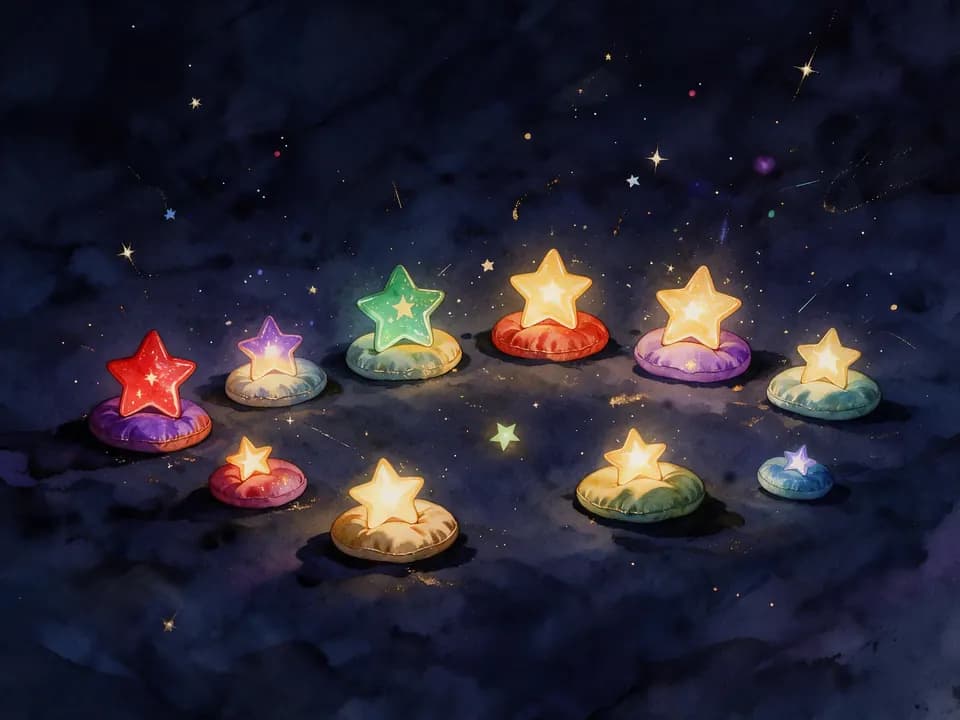
The same star, different cells
Put the same Tai Yang in Mao or in Zi, and practitioners read two very different pictures.The star's personality hasn't changed. What changes is how comfortable it is in that cell.
The fourteen main stars
There are over a hundred stars on a chart, and the weightiest are the fourteen main stars. They set a palace's basic character, and the other stars add to it.Over the next few lessons, you'll meet them two at a time.
Two teams, two captains
The fourteen main stars form two teams.Zi Wei leads Tian Ji, Tai Yang, Wu Qu, Tian Tong and Lian Zhen, placed counterclockwise.Tian Fu leads Tai Yin, Tan Lang, Ju Men, Tian Xiang, Tian Liang, Qi Sha and Po Jun, placed clockwise.
Stars have brightness too
Brightness describes how comfortable a star is in a given cell. From brightest to dimmest there are seven grades: Miao, Wang, De, Li, Ping, Bu and Xian.Miao and Wang is a home game; Xian is an away game.
Home and away
Dim doesn't mean bad
A star at Xian isn't a bad star. Tai Yang at Xian is still warm; it just tires more easily and works harder at it.Knowing which stars take more effort tells you where to save a bit of energy.
Entering the temple is remarkable; losing its measure is hollow.
In plain wordsA star in a Miao or Wang position expresses its traits well; in the wrong position it seems hollow and can't put its strength to use.
Brightness on your chart
Stars at Miao or Wang come easily to you; for stars at Xian, that area takes a bit more effort.
Your chart has 8 main stars at Miao or Wang and 2 main stars at Xian or Bu.
- Miao, Wang
- Lian Zhen (Health Palace), Po Jun (Children Palace), Tian Tong (Spouse Palace), Wu Qu (Siblings Palace), Tian Fu (Siblings Palace), Tian Ji (Fortune Palace), Ju Men (Fortune Palace), Qi Sha (Friends Palace)
- Xian, Bu
- Tai Yin (Life Palace), Tian Liang (Career Palace)
This is a sample chart. Enter your birth details and this card switches to your own chart. Draw a chart ›
Of the seven brightness grades, which is brightest?
- Miao
- Wang
- Ping
See answer
Miao
The order is Miao, Wang, De, Li, Ping, Bu, Xian. Miao is the brightest and Xian the dimmest.
First see which star it is, then see how bright it is.
Deeper reading
The fourteen main stars at a glance
Xingge gives each main star a role to make it easier to remember:
- Zi Wei: The Emperor. Opinionated and proud, and needs people to back it up.
- Tian Ji: The Strategist. Quick-minded and full of ideas, and prone to overthinking.
- Tai Yang: The Navigator. Warm and giving, lighting others up first.
- Wu Qu: The Financier. Practical and decisive; only results count.
- Tian Tong: The Sunshine. Easygoing and pleasure-loving; hardship first, sweetness later.
- Lian Zhen: The Judge. Strong principles and strong emotions, with real magnetism.
- Tian Fu: The Steward. Steady and good at holding on; at ease only when there's something to guard.
- Tai Yin: The Poet. Attentive, gentle and in need of security.
- Tan Lang: The Player. Multi-talented and sociable, and wants a lot from life.
- Ju Men: The Debater. Always asking why; its words carry weight.
- Tian Xiang: The Chancellor. Fair, good at mediating, mindful of image.
- Tian Liang: The Elder. Loves looking after people and sticks to principles.
- Qi Sha: The General. Independent, driven, unafraid to decide.
- Po Jun: The Breaker. Restless with the status quo; tears down to rebuild.
These roles are a memory aid Xingge put together for you, not the original text. What the classics say, each later lesson quotes directly.
Two star groups
When the stars are placed, Zi Wei's position comes first, and from Zi Wei come Tian Ji, Tai Yang, Wu Qu, Tian Tong and Lian Zhen counterclockwise (skipping a few cells along the way). This is the Zi Wei group. Tian Fu's position mirrors Zi Wei's, and from Tian Fu come Tai Yin, Tan Lang, Ju Men, Tian Xiang, Tian Liang, Qi Sha and Po Jun clockwise. This is the Tian Fu group. So the positions of the fourteen main stars relative to each other are fixed: once you know where Zi Wei is, the other thirteen follow.
That's also why certain stars often live together, like Zi Wei and Tian Fu sharing a palace in Yin or Shen, or Tian Ji and Tian Liang in Chen or Xu. This chapter pairs up stars that often appear together.
Where the seven grades come from
The seven grade names come from the brightness table in volume two of the *Quan Shu*, whose headings are: Miao (Temple), Wang (Prosperous), De Di (Gaining Ground), Li Yi (Profit), Ping He (Average), Bu De Di (Unsupported) and Luo Xian (Fallen). In everyday use they're shortened to Miao, Wang, De, Li, Ping, Bu and Xian. The rhapsodies in volume one mostly speak only of the two ends, "Miao and Wang" and "Xian"; it's this table in volume two that splits them into seven grades.
- Miao: the most comfortable position, where the personality is most complete.
- Wang: very much at ease.
- De, Li: not bad; the traits come through.
- Ping: ordinary.
- Bu, Xian: more awkward, needing extra effort.
A few easy examples: Tai Yang is brightest in Mao and falls to Xian in Hai and Zi, like the sun going down; Tai Yin is the opposite, brightest in the night cells of Hai, Zi and Chou, and at Xian in Mao, Chen and Si. Zi Wei, Tian Fu, Wu Qu and Qi Sha have no Xian position on the table, and when volume three of the *Quan Shu* lists brightness star by star, it notes "no fall" after these four as well. Different schools' brightness tables differ slightly; Xingge uses this one table from volume two of the *Quan Shu* throughout, checked cell by cell.
Two common mix-ups
First, brightness depends on the cell's Earthly Branch, not the palace name. If your Tai Yang sits in your Wealth Palace, look at which branch your Wealth Palace is in: in Mao it's Miao, in Zi it's Xian. The same Tai Yang on someone else's chart may have a completely different brightness.
The *Quan Shu* sometimes also uses words like "temple-happy" and "fallen-weak" about palaces. For example, it says Tian Fu "takes Property and Wealth as its temple joy, and Servants and Appearance as its weakness". That's saying which kinds of matters Tian Fu handles best (land and money), which is a different thing from the branch-based brightness table, so keep them apart when reading the classics.
Second, brightness isn't a score. On Zi Wei, the *Quan Shu* says that "at Miao or Wang and transforming well, it is excellent; at Xian and transforming badly, it is very difficult": brightness has to be read together with the Four Transformations. At Miao or Wang with Hua Lu, it's smooth on top of smooth; at Xian with Hua Ji, it's hard on top of hard; most cases fall in between and need reading cell by cell. In practice, practitioners first treat brightness as a star's "foundation", then add and subtract based on the transformations, the stars sharing the palace and the San Fang Si Zheng.
Hua Qi: each star's essence
The classics give many main stars a single word called its "Hua Qi", something like the star's essential nature: Zi Wei transforms into Honor (the common later label; the *Quan Shu* calls it "the honored star of the central heavens" and says it "becomes the imperial seat"), Tian Ji into Goodness, Tai Yang into Nobility, Wu Qu into Wealth, Tian Tong into Blessing, Lian Zhen into Restraint, Tai Yin into Riches, Tan Lang into Peach Blossom, Ju Men into the Hidden, Tian Xiang into the Seal, Tian Liang into Shelter and Po Jun into Consumption. Each later lesson explains these in plain language.
Terms in this lesson
- main star
- The fourteen weightiest stars. They set a palace's basic character, like the owner of a room.
- Zi Wei
- The Emperor Star: self-assured and proud, at its best with capable people around it.
- Tian Fu
- The Treasury Star: steady and careful, at ease when there is something to safeguard.
- brightness
- How well a star performs in a given cell: Miao and Wang are strongest, Xian is the most awkward.
- Miao and Wang
- A star in its most comfortable position, expressing itself most fully and positively.
- Xian
- A star in an awkward position. Its traits are still there, just harder to use and in need of more effort.
- Four Transformations
- Hua Lu, Hua Quan, Hua Ke and Hua Ji: four impulses that set the stars in motion.
- San Fang Si Zheng
- The palace, its opposite and its two trine palaces. Read the four together for the full picture.