 Xingge
Wu Qu and Tian Xiang: the Financier and the Chancellor
One gives you the answer straight, the other keeps everyone on side · 4 min
Not on the transformation table
You won't find Tian Xiang on the transformation table. To judge how well it can express itself, the ancients looked instead at who lives in the two cells on either side.The other star in this lesson, Wu Qu, is the famous wealth star.
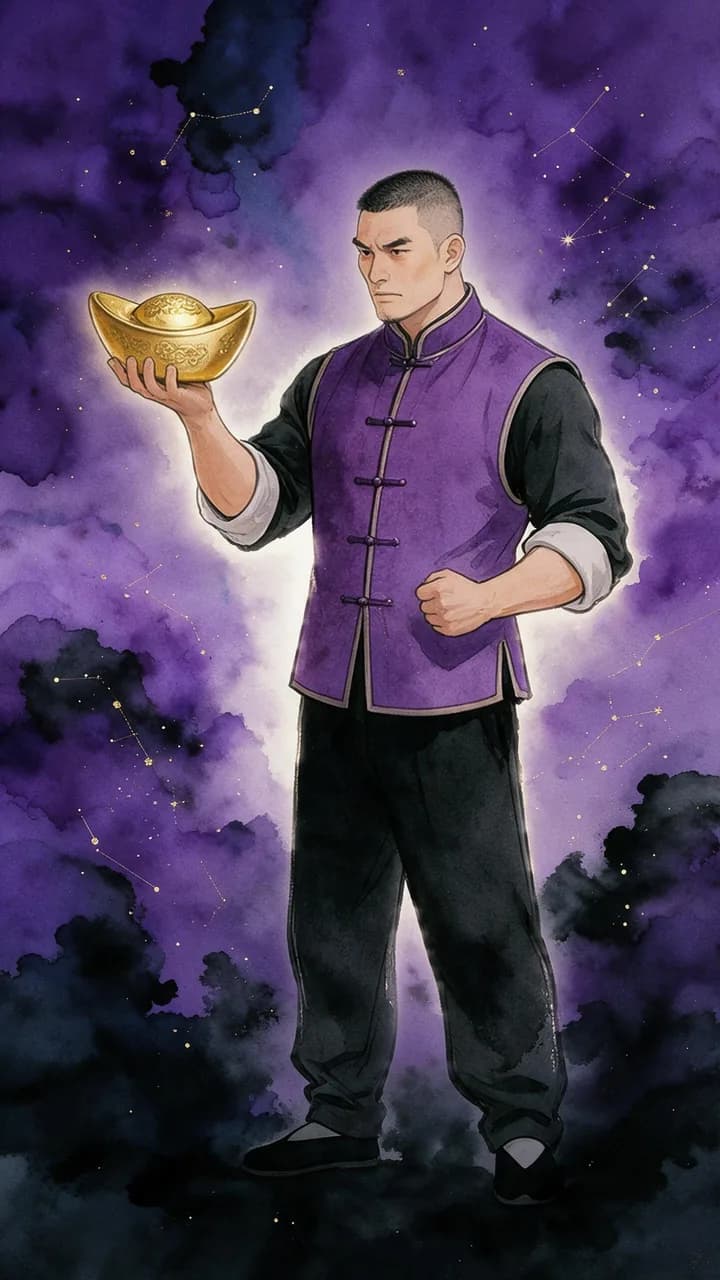
Wu Qu: the wealth star
Wu Qu transforms into Wealth, and is also a general star. A friend with a strong Wu Qu speaks plainly. Ask for advice and they ask about the budget and the deadline first. What they promise gets done, though not always with kind words.They show they care by doing, not saying.
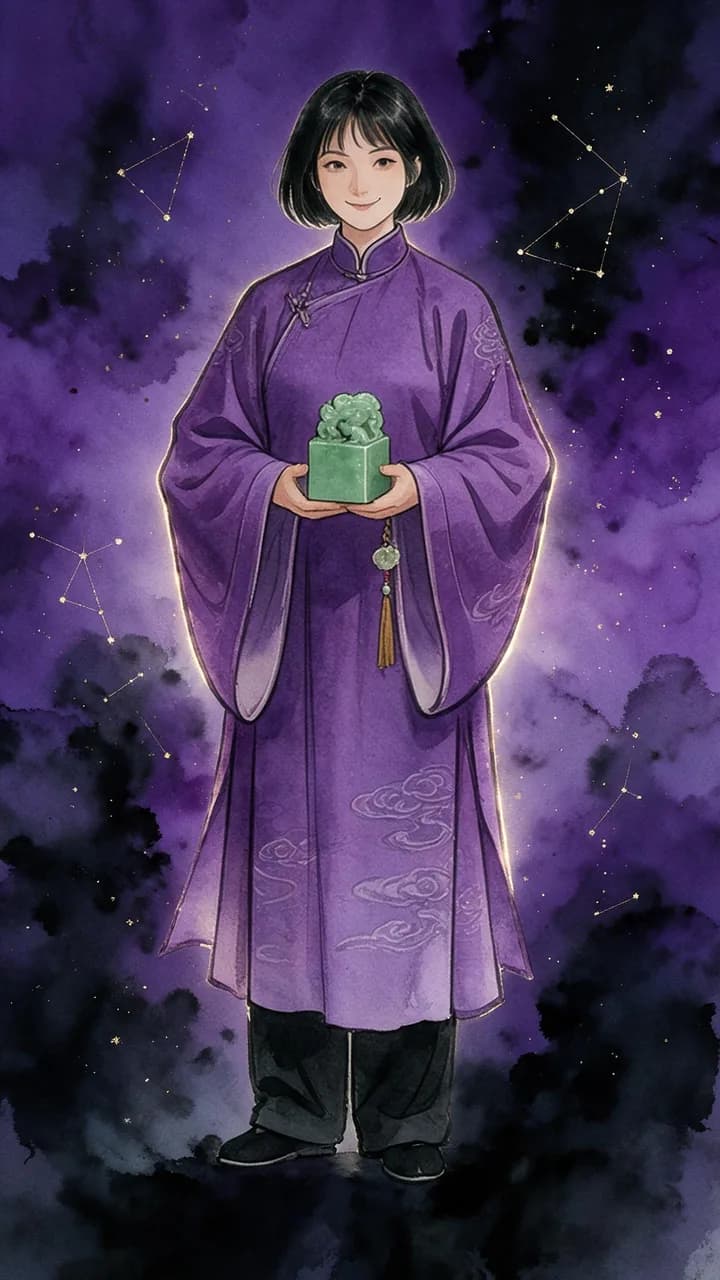
Tian Xiang: the Chancellor
Tian Xiang transforms into the Seal, the official seal of old China: once stamped, it's an endorsement. A friend with a strong Tian Xiang is the group's mediator. When two sides argue, they listen to each separately, then find a version everyone can accept.
Tian Xiang looks at its neighbors
Tian Xiang is strongly shaped by its surroundings, so the ancients looked at who sits in the two cells beside it, called the flanking palaces.By the rules for placing the stars, Tian Xiang is always flanked by Ju Men and Tian Liang.
Wu Qu and Tian Xiang together
Wu Qu belongs to Zi Wei's team and Tian Xiang to Tian Fu's. The two share a palace in Yin and Shen.The one who makes the call and the one who smooths things over in the same cell: practical, with an eye on the big picture.
Tian Xiang is the star of the Southern Dipper that governs rank; its Hua Qi is the Seal.
In plain wordsTian Xiang governs rank and seals of office. Stamping a seal is endorsing something, so Tian Xiang comes across as dependable and measured.
Where Wu Qu and Tian Xiang are for you
In the room where Wu Qu sits, you value results; in the room where Tian Xiang sits, you look after everyone.
Wu Qu is in your Siblings Palace, and Tian Xiang is in your Property Palace.
- Wu Qu
- Siblings Palace (Wu) · Wang
- Tian Xiang
- Property Palace (Xu) · De
This is a sample chart. Enter your birth details and this card switches to your own chart. Draw a chart ›
What did the ancients often look at to judge Tian Xiang?
- The stars in the two cells on either side
- The season of birth
- Whether you've moved house
See answer
The stars in the two cells on either side
Tian Xiang is strongly shaped by its surroundings, so the ancients looked at who lives in its flanking palaces.
To judge Tian Xiang, look at its neighbors first.
Deeper reading
Wu Qu: transforms into Wealth
The *Quan Shu* calls Wu Qu "the sixth star of the Northern Dipper" and "lord of the Wealth Palace", and says that "in the heavens it governs longevity; in the chart it governs wealth". Its Hua Qi is Wealth; in plain terms, it values results and practicality, and things only count once they're real. The *Quan Shu* describes Wu Qu people as "firm and decisive by nature, quick to joy and to anger", so practitioners tend to read people with Wu Qu in the Life Palace as decisive, straightforward and good at getting things done. They're not great at saying nice things or expressing feelings, but whatever they can do, they do.
Wu Qu's brightness is very steady: Miao in Chen, Xu, Chou and Wei; Wang in Zi and Wu; Ping in Si and Hai. Volume three states plainly that it has "no fall". The ancients called Chen, Xu, Chou and Wei the "four tombs", places of storage, and a wealth star is best kept in the vault.
There's an often-quoted line in the classics:
Wu Qu guarding Life brings no small fortune; with Tan Lang, it does not flourish in youth.
It's preceded by the line "meeting Tan Lang, youth is unfavorable", so it's about Wu Qu meeting Tan Lang: Wu Qu in the Life Palace carries no small fortune, but when it shares a palace with Tan Lang or meets it, success often doesn't come young. Wu Qu and Tan Lang share a palace in Chou and Wei, right in the tomb cells, and the "Gu Sui Fu" says "Tan Lang and Wu Qu living in the tomb, fortune only blooms at thirty". For a young person, in plain terms: this combination's rhythm gets steadier the longer you work at it. Not being able to save in your twenties doesn't mean you never will.
Tian Xiang: transforms into the Seal
Tian Xiang is "the star of the Southern Dipper that governs rank", and its Hua Qi is the Seal. The Seal was the official seal of old China; stamping it meant giving an endorsement. People with Tian Xiang in the Life Palace often come across as fair, dependable and image-conscious, the best in the group at mediating and smoothing things over. The *Quan Shu* says it "seeing others in difficulty, feels compassion; seeing others wronged, feels indignant", and that it "assists the light of Sun and Moon, and tempers the harshness of Lian Zhen": it can help others shine, and can calm intense energies down.
Tian Xiang's brightness is mostly good; it's only at Xian in Mao and You.
Tian Xiang and its flanking palaces
Later practitioners pay special attention to the two cells on either side of Tian Xiang, its flanking palaces. By the rules for placing the stars, Tian Xiang is always flanked by Ju Men and Tian Liang, so how it fares often depends on Ju Men's cell:
- With Ju Men taking Hua Lu and Tian Liang (Shelter) on the other side, later practitioners call it "wealth and shelter flanking the Seal": your surroundings support you.
- With Ju Men taking Hua Ji and Qing Yang on the other side, later practitioners call it "punishment and Ji flanking the Seal": caught in a tug of war, needing more effort.
"Wealth and shelter flanking the Seal" appears in the *Quan Shu*'s "Patterns of Wealth", which originally reads "Tian Xiang guarding Life, flanked by Wu Qu and Tian Liang", where "wealth" meant Wu Qu. Because by the placement rules Wu Qu can never sit next to Tian Xiang, later readers reinterpreted it as Ju Men with Hua Lu. "Punishment and Ji flanking the Seal" is a later term; the "Tai Wei Fu" in the *Quan Shu* only has the line "punishment and restraint flanking the Seal, governing only the rod", usually read as Qing Yang (punishment) and Lian Zhen (restraint) coming together with Tian Xiang.
Interestingly, the *Quan Shu* itself thinks highly of Tian Xiang's own steadiness, saying it "does not change its resolve to follow wrongdoing, and does not shift because of Qi Sha". The two views can be held together: Tian Xiang itself stands firm, but its job is to endorse others, and whom it endorses makes a big difference to the outcome. Think of it at work: the same chief of staff is a right-hand person to a good boss, and the one cleaning up messes for a bad one.
Wu Xiang, a pair
Wu Qu belongs to the Zi Wei group and Tian Xiang to the Tian Fu group; the two share a palace in Yin and Shen. Here Wu Qu is at De and Tian Xiang at Miao: one makes the call, the other smooths things over, practical and mindful of the big picture. It's often seen in roles that manage both money and people.
A note on the transformations
By the transformation rhyme in volume two of the *Quan Shu*, Wu Qu takes Hua Lu in Ji years, Hua Quan in Geng years, Hua Ke in Jia years and Hua Ji in Ren years. Tian Xiang takes no part in the transformations at all; it's one of the few main stars you won't find on the table, which is why its neighbors matter so much more.
Terms in this lesson
- Wu Qu
- A wealth star and a general: practical and decisive, judged by results, not one for sweet talk.
- Tian Xiang
- The minister star: fair, cooperative and image-conscious, shaped by the stars on either side.
- flanking palaces
- The stars on either side of a palace, like two neighbors, which squeeze and shape the palace between them.